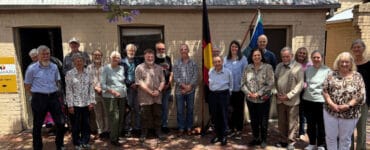
A theological conversation on Country
On 12 December 2025, the Victoria Treaty between the state of Victoria and First Peoples officially came in...

The Religion and Social Policy Network (RASP) supports the University of Divinity’s research endeavour by facilitating the work of its members to create and disseminate new knowledge about the intersection of religion and social policy.
We provide a forum for members to test and develop their ideas and provide encouragement to members in our shared endeavour of creating a more just and inclusive society, underpinned by good research and theologically informed social policy.
The Religion and Social Policy network brings theological insight into contemporary world issues and social policy debates—by stimulating research and engagement activity across the University and by building external partnerships.
RASP aims to transform conversations in the public space by research enlivened by faith and theology and by engagement with public policy issues, propose publicly policy ideas arising from our research and theological reflection.
RASP’s interests are broadly defined by the environment climate change, health and economy. The Network’s focus on God’s ‘justice and righteousness’ intends to be inclusive of members’ interests, such as human rights, including of domestic and international refugees and migrants, peace and conflict and, issues arising in multicultural society.
We believe that since the colonial invasion of Australia the privatisation of religious faith removed faith’s critical voice about social policy from the public square and diminished a mode of being that distorted the truth disclosed by objective rationality.
We seek to use theological discernment as a mode of being to critique and challenge political and economic ‘rationalism’, in particular to be in solidarity with Indigenous Australians arguing for justice for marginalised and disadvantaged people in our society.
The RASP Network seeks to be a collegial community of passionate researchers who share a range of faith commitments and who seek to engage our faith in justice issues of public policy.
Members of RASP regularly contribute to public commentary on current social policy issues. The University consists of twelve colleges representing a diverse range of Christian traditions so most articles will reflect the perspective of our members but in engagement with a range of other perspectives.
Disclaimer: The University of Divinity does not accept any responsibility or liability for the opinions expressed in these pages.
On 12 December 2025, the Victoria Treaty between the state of Victoria and First Peoples officially came in...

A University of Divinity study of ten Australian bank employees brings to light a hidden spectre of suicide in Australia’s banks....
Book on application of Christian ethics to health...

The Statement from the Heart calls RASP and all...
The University of...
John Bottomley, Chairperson for the Religion a...
This article is republished from Mirage new...

Rev Dr Andrew Sloane, Morling College and member of RASP This article is reposted from The Canberra Times It’s been...
Michael Toy | Reposted from Ethos, with permission. We learn to listen better so that we can learn to live better. –...

Measurement, Meaning and Mindfulness in Health, Education and Work Elizabeth Anscom...
RASP contributes to a number of public events during the year. Visit the University’s Vox (News and Events) website for information about public events coming up near you.
23 April 2019
Earth@Peace: A Just and Ecologically Sustainable Peace conference was held on April 23–24, 2019, at the Centre for Theology and Ministry in Parkville, Victoria. It was organized under the auspices of the Centre for Religion and Social Policy (RASP) alongside partners Pax Christi, Ethos, Australian Research Theology Foundation, Social Policy Connections and several other supporters.
13 June 2018
RASP hosted its second major public event on June 1, 2018, focusing on the national Ruddock Inquiry into religious freedom. Chaired by broadcaster John Cleary, the event featured key speakers analyzing the intersection of faith, law, and modern Australian society. Speakers included Fr Frank Brennan SJ AO, Dr Sharon Rodrick (Institute for Civil Society) and Revd Dr Robyn Whitaker (Theological Perspective, University of Divinity).
29 June 2017
RASP hosted its first major public event on 29 June 2017 – a conversation on ‘End of Life Choices: Voluntary Euthanasia & Assisted Suicide in Victoria’ between world-renowned bioethicists Professor Peter Singer (Princeton University and the University of Melbourne) & Professor Margaret Somerville (University of Notre Dame, Sydney and formerly McGill University, Montreal).
Under the overall focus of Flourishing in a Fragile World, these themes help RASP focus its research efforts but are not exclusive. They will be regularly informed by Indigenous, inter-generational, gender diverse, multicultural and multi-religious sources and dialogue.
Theologically, our earthly home (oikos) or Creation is intrinsically ‘good’, beautiful and purposeful, abundant yet finite. This sits in tension with a rising sense of the fragility, scarcity and exploitation of these qualities. Belief in nature as infinite raw material for utilitarian quantification and commodification threatens Creation. It is urgent that humankind connects a theology of cosmic reconciliation with the practical urgency of the plight of the earth and the poor, as victims of violence and injustice. The positive reception to Pope Francis’ lyrical Laudato Si’ encourages us to develop further the Yarra Institute’s religiously-based research into social policy for the flourishing of creation.
Economy also comes from the root oikos, both linked to and enveloped by ecology. It is not reducible to mere economic prosperity or growth (GDP). RASP encourages research into a more social and ecological economy which sustains a dynamic relationship between the two dimensions. This will be expressed in two primary projects: Critical turning or crisis points in the history and future of capitalism; The increasingly global phenomenon of precarious or fragile work threatening sustainability of current models of work, family and community life.
Economy Research by RASP Member John Bottomley
The language of Wellbeing is increasingly moving into religion’s traditional realm. It potentially integrates the personal, communal and political through more holistic and spiritual approaches to the mysteries of illness, death and the nature of human life than current western medical models. Key generational and historical injustice issues to be addressed include indigenous inequalities, aging, youth unemployment, domestic violence, abuse, and mental illness. The religious quest for flourishing (e.g. shalom, abundant life) connects with these pressing wellbeing issues and their ecological, economic and spiritual causes. Such healing contributions could help restore the sense of safety, transparency and authenticity of the church’s pastoral practices and services to society amidst pressures towards secularisation, privatisation and centralisation.
Support the work of RASP by applying to become a Member.
The purpose of appointment as a member of the Religion and Social Policy is to promote and foster the work of the network through:
Members of RASP will also have the opportunity to engage together in religious and social policy dialogue under the network’s auspices. Those with a religious faith will also be given opportunities for participating in intentional conversations that are integrative of their faith and professional research and social policy practice.
Membership of RASP is accorded to collaborators who take part in the work of the network on a regular basis or during a period of at least three months based at, or otherwise working with the network. The status implies a significant contribution to the work of RASP. While membership is usually honorary, members are not precluded from receiving remuneration for undertaking specific assignments for the network.
The Management Group may appoint as Members of RASP persons who are able to contribute to its aims.
Appointment as an Associate Member of RASP is accorded to collaborators who take part in the work of the network on a regular basis or during a period of at least twelve months working with the network. The status implies a significant contribution to the work of the network. While an Associate Member of RASP is an honorary role, Associate Members are not precluded from receiving remuneration for undertaking specific assignments for the network.
If you would like to apply to become a member, please email, together with a statement detailing how you propose to contribute to the work of RASP, a short curriculum vitae (up to 5 pages) detailing current and previous research and/or other professional contributions relevant to the work of the University of Divinity and the Religion and Social Policy network.