The Australian Collaborators in Feminist Theologies network aims to consolidate and energise the University’s commitment to the participation of women and feminist scholars in the academy and the wider church. By fostering and forwarding feminist voice and vision we aim to promote Gospel justice by addressing issues relating to gender equality, class, race, sexuality, and ability.
It aims to be a centre of excellence in feminist theological scholarship and in mentoring academics so as to challenge and transform patriarchal structures and assumptions in the academy, church, and wider world.
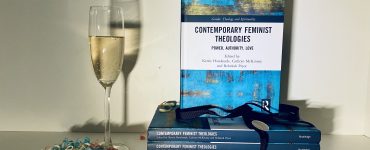
This list will be added to regularly as further publications become available.
In preparation:
To find out more about units, including when it is next scheduled, type the unit title or code into the UMS search bar.
This unit will explore queer theology as it has emerged from queer theory, LGBTIQ justice struggles, and faith development and practice. It will acquaint students with the history and challenges of the term ‘queer’, and introduce the multiplicity of lesbian, gay, bisexual, transgender, intersex, and queer Christian theologies that have emerged in recent decades. It will seek to analyse and critique theological loci and motifs of Christian theology, including the queering of scripture and hermeneutics and key theological doctrines. Exploring intersectional approaches, including postcolonial perspectives, queer art, action and contemporary reflection, participants will be enabled to assess critically the value and possibilities of queer theology for faith and society today.
Unit codes: CT3001P, CT9001P
This unit explores the meaning of Christian spirituality using the writings of women throughout history. Emphasis will be placed on the historical context of the primary sources used, the struggles of women in coming to find their own voices within their contexts, the theological relevance of their writings, and the specific literary genres that they used. This study enables students to appreciate both the significance of these writings for their own times, as well as their continuing relevance to our life and mission in the Christian Church today.
Unit codes: CH2215Y, CH3215Y, CH9215Y, DS2215Y, DS3215Y, DS9215Y
This unit explores the relationship between issues of gender, justice and empire in Old Testament interpretation. Through a study of a number of Old Testament texts, particularly those which narrate the experience of women within the wider social and imperial contexts, we will consider how these themes are configured and related within biblical traditions. We will engage in a close reading of a range of primary Old Testament texts and contemporary feminist/womanist and other (culturally diverse) scholarship about these texts and will also examine how these hermeneutical perspectives engage and critique traditional exegetical approaches. The approach will be interdisciplinary and will provide students opportunity to study these texts alongside contemporary women’s experiences and portrayals of women in other media such as art, film, poetry and law.
Unit codes: BA2040P, BA2049P, BA3040P, BA3049P, BA9040P, BA9049P
The books of Esther, Ruth, the Song of Songs, Susannah, and Judith are exceptional and exciting. These books with women protagonists came to life within a strong patriarchal culture with strong gender stereotypes and multiple barriers to women. They are well known for their powerful narrative art and imagination. Are the woman protagonists in these books, feminist heroines or patriarchally idealised stooges? Or are they protest and subversive literature? These books will be introduced in this unit; the stories contained in these books are retold and analysed in their allusive complexity. We will attend to issues of identity, gender, sexuality, beauty, power, solidarity/partnership, widowhood, their representation in the visual arts, the function of these books and their contemporary relevance.
Unit codes: BA3070P, BA9070P
In this unit we ask three key questions: ‘How has Mary of Nazareth, the mother of Jesus, been understood in various Christian communities? What is the significance of devotion to Mary for feminist theologies? How do feminist perspectives refresh, inform and refract the figure of Mary?’ This unit proceeds in two steps: first, to introduce a range of marian doctrine and devotion from different contexts over time; second, to consider contemporary feminist theological engagement with marian theology and spirituality. Some writers are Roman Catholic; some are Protestant; others are post-Christian; most are so-called “first world” European or North American, others are Latinx (and more voices from other cultures are also represented in the readings). Some define their work as liberationist or queer, but all identify as feminist—though given their contexts and convictions, they mean somewhat different things by this, in terms of catholicity, protest, reform and other theological dynamics.
Unit codes: CH3101P, CH9101P, DL3101P, DL9101P
Conducted in seminar style, Readings in Feminist Theology is based around primary texts. While the unit contextualises readings in the corpus of work of their authors, it is focused on intensive engagement with representative texts that mark focal figures’ major contributions to feminist theology in different global contexts. To order the exploration of the theologians’ work, special attention will be given to two tropes in their work: Christology and leadership in Christian community.
Unit codes: CT3400P, CT9400P
This unit explores the contribution of feminist scholarship to Christian theology. It surveys the history of feminism as a term, charts the growth of significance within theological discourse since the 1980s and of resistance to it. It considers the significance of feminist methods, hermeneutics and approaches to reading and interpreting Scripture, and the consequent impact on feminist theologizing, analysis of Christian doctrine, and the understanding Christian tradition and liturgical life. It pays particular attention to the intersection of feminism with other theologies of liberation, against structures of oppression. Considering a range of contemporary social issues, this unit examines the actual and potential contribution of feminist insights to shaping nuanced and vibrant theological perspectives.
Unit codes: AH9100P, BS9100P
Paul’s injunction that women remain silent in the Church (1 Cor 14: 34-36) could be said to have led to a significance absence of Women’s Wisdom from the official teaching of the Church over its 2000 year history. Of the 37 Doctors of the Church, only 4 are women, Teresa of Ávila, Catherine of Siena, Thérèse of Lisieux and Hildegard of Bingen, all of whom have only been recognised in the last 50 years. This unit will concentration on the contribution of these women to our theological understanding of God and also explore other important female voices that have been overlooked through the centuries.
Unit codes: CH3217Y, CH9217Y, DS3217Y, DS9217Y
Rev Dr Sally Douglas, Uniting Church Minister, biblical scholar and theologian
(‘Power, Authority, Love’, 11-12 October 2019)
Dr Janice McRandal, Director, The Cooperative and feminist theologian
(‘Power, Authority, Love’, 11-12 October 2019)
Prof. Nicola Slee, Director of Research, Queen’s and Professor of Feminist Practical Theology at the Vrije Universiteit, Amsterdam https://www.queens.ac.uk/people/academic/nicola-slee (‘Feminist Ethos in the workplace: “Presiding in the Classroom” essay, reflections 10 years on’, 7 October 2019; ‘Witnessing to What Remains, or, The Power of Persisting: Power, Authority, and Love in the Interim Spaces’ Jan Gray Memorial Lecture, 11 October 2019; ‘Practical Theology for Fractured Times’, 21 October 2019)
Dr Paula Gooder, Author and Lecturer https://www.gooder.me.uk/ (‘Phoebe: A Story with Paula Gooder’, 2 August 2019)
Commissioner for Gender and Sexuality, Ro Allen (‘Sex & Politics’, 22 May 2019)
Dr Alana Harris, Director of Liberal Arts and Senior Lecturer in Modern British History at King’s College London https://www.kcl.ac.uk/people/alana-harris (‘Sex & Politics’, 22 May 2019; ‘Gender Equality in Academia’, 24 May 2019)
Prof. Joy Damousi, University of Melbourne, President Australian Academy of the Humanities, Australian Historical Association https://arts.unimelb.edu.au/school-of-historical-and-philosophical-studies/our-research/arc-kathleen-fitzpatrick-laureate-fellowship/researchers/professor-joy-damousi (‘Testament of Mentors: Feminist Engagement in Academia’, 31 August 2018)
Rev Dr Jione Havea, author and academic, Methodist pastor from Tonga and research fellow with Trinity Methodist Theological College (Aotearoa / New Zealand) https://www.linkedin.com/in/jione-havea-4892b87b/?originalSubdomain=nz (‘The State of Feminist Biblical Scholarship’, 11 May 2018)
Prof. Gerald West, University of KwaZulu, Natal https://srpc.ukzn.ac.za/staff-profile/theology/gerald-west/ (‘The State of Feminist Biblical Scholarship’, 11 May 2018)
Prof. Linn Tonstad, Yale Divinity School https://divinity.yale.edu/faculty-and-research/yds-faculty/linn-tonstad (‘Gender, Personhood, and Difference in Recent Trinitarian Theology’ 8 December 2017)
Rev. Dr Cynthia Wilson, Executive Director, Worship Resources for Discipleship Ministries at United Methodist Church https://www.umcdiscipleship.org/about/press-center/cynthia-wilson-named-associate-general-secretary-at-discipleship-ministries (“With all due respect…”: theology, feminism and conflict, 2-3 August 2017)
Dr Ruth C. Duck, Professor of Worship at Garrett Evangelical Theological Seminary, Evanston, Illinois; and Fellow of the Hymn Society https://www.garrett.edu/news/ruth-c-duck-honored-fellow-hymn-society (“With all due respect…”: theology, feminism and conflict, 2-3 August 2017)
Dr Elaine Wainwright RSM Executive Leader Mission and Ministry for the Institute of Sisters of Mercy of Australia and Papua New Guinea (ISMAPNG) https://www.mercyworld.org/library/elaine-wainwright-rsm428/ (Feminists Navigating Theological Disagreement,15 October 2016; Inaugural Janette Gray Lecture “A tapestry of woven threads”, 31 August 2018)
Rev. Dr Seforosa Carroll, Theologian and academic Programme Executive for Mission and Mission from the Margins, World Council of Churches. https://www.oikoumene.org/news/wcc-welcomes-new-staff-0 (‘Bodies of Difference: Gender, Race and Ministry’ , 1 August 2017; “With all due respect…”: theology, feminism and conflict, 2-3 August 2017)
Prof. Adela Yarbro Collins American author and academic, Yale Divinity School divinity.yale.edu (‘The State of Feminist Biblical Scholarship’, 11 May 2018)
Prof. M. Shawn Copeland Professor Emerita of Systematic Theology at Boston College ncroline.org (‘With All Due Respect’ Feminist Theologies Symposium, 23 May 2017)
Rev Dr Serene Jones President of Union Theological Seminar utsnyc.edu (Australian Collaborator in Feminist Theologies: Inaugural Gathering, 8 July 2016)
18 January 2021
The Australian Collaborators in Feminist Theologies and University of Divinity partnered with Brave Network and SOGICE Survivors to present a community briefing on what conversion practices are, an overview of this legislation, a theological response, and how to be an effective advocate from theologians, academics, policy experts and survivors. The event was hosted by Chris Csabs and Katecia Taylor. Speakers included: Cath McKinney, Robyn Whitaker, Beth Barnett, Abanob Saad, Nicole Mugford, Patrick McIvor, Nathan Despott and Alix Butler.
16 September 2020
Simply existing as a transgender person is to share a dangerous vocation. For humanity constructs its worlds with a multiplicity of constricted shapes and identity lines. Some give life but at the cost of violence. Altering forms thus inevitably involves conflict, even lateral violence between different identities struggling for liberation. In this HORIZONS conversation, the Revd Dr Josephine Inkpin and Dr Cathryn McKinney discuss the violence and danger faced by trans people and the significant gift of wisdom and liberation that trans people and theological perspectives offer for us all.
19 August 2020
The many lives of women have been profoundly affected by life in a pandemic. In this HORIZONS conversation with Dr Janice McRandal and The Revd Sharon Hollis, we discuss just a few of the worrying dynamics unfolding around us, within our churches, at our universities, and from our government.
15 July 2020
From the catchment areas of the drinking water our lives depend on, to the globally wide-reaching impacts of climate change and COVID pandemic, how can our discipleship and practice in feminist theologies be informed and inspired by leading voices at the front lines of church, academia, activism and economics?
In this ‘climate of change’, how can we work and advocate for environmental justice in the months ahead, committing our hope to a better future than is offered by a ‘return to normal’. How do we invest our resources: money, time, bodies, voices in a horizon more hopeful and what might that look like?
Women are more adversely impacted during disasters – first bushfires and now COVID – they are more likely to be unemployed, more likely to be doing unpaid work as carers, more likely to be working in essential worker frontline roles such as in health care, the aged & disability care sector, in early childhood education, teaching, cleaning and retail and instances of domestic violence can increase. If the impacts of disasters are gendered, how can our response be gendered as individuals, churches and organisations? There is an opportunity presented by this global disruption to transform Australia into a more resilient, inclusive and equitable society.
For this inaugural HORIZONS event, Talitha Fraser (Australian Collaborators in Feminist Theologies) is in conversation with Maria Tiimon Chi-Fang (Pacific Outreach Officer, Edmund Rice Centre, Pacific Calling Partnership), Thea Ormond (President, Australian Religious Response on Climate Change), Dr Di Rayson (Academic, School of Humanities and Social Sciences, University of Newcastle) and Jon Cornford (Director, Manna Gum).
22 May 2019
On 22nd May 2019, the Australian Collaborators in Feminist Theologies were pleased to present Alana Harris, visiting scholar from Kings College, UK, who delivered a lecture in relation to her own work: The history of the decriminalisation of homosexuality in Britain (1967). Victorian Commissioner for Gender and Sexuality, Ro Allen, responded from the context of local issues around the status of conversion therapy and the political interventions that are presently underway here in Australia.
In 2014, there was an initial meeting with representation from University’s colleges (Whitley College, Trinity College Theological School, Jesuit Theological College, Pilgrim Theological College, Stirling College, and Catholic Theological College) to assess the interest in formal, feminist, theological engagement within the context of the University of Divinity. In 2016, members informally organised guest lectures from Sarah Coakley and Gene Robinson when they were visiting Melbourne. During this time there were regular meetings of interested parties.
The decision was made early on to call this group “Australian Collaborators in Feminist Theologies” to establish that there was a wide variety of disciplines, perspectives, denominations, and theological practices present. Collaboration has been a fundamental mode of operation that reflects feminist ideals.
We are an ecumenical, scholarly group that has formed partnerships across University of Divinity colleges and into other networks around Australia.
Dr Rebekah Pryor
President and Convener
Ms Katherine Jelavic
Vice President
Ms Sarah Glover
Secretary and Communications Portfolio Lead
Professor Katharine Massam
Treasurer
Rev Dr Sally Douglas
Member
Rabbi Dr Aviva Kipen
Member and Membership Portfolio Lead
A/Prof Kerrie Handasyde
Research and Publications Portfolio Lead
Ms Talitha Fraser
Events Portfolio Lead